Same day appointment

After suffering and being told by the doctors I Just had a muscle strain a friend recommended the Osteopathic Centre. I emailed them in the morning and had an appointment booked for that same evening.

The consultation was very thorough and I found out I had actually a more specific issue which was treatable there and then. I had one more follow up treatment and have been amazed by how much better my back feels. Thank you so much!

Jacqui D

Improvement

First class service and done with care and attention to detail. Improvement in my condition has helped considerably.

Brian M

A personal approach

A professional yet personal approach which makes me feel at ease. They have won my trust with diagnosis and treatment so much that I always recommend them to my friends.

Helen T

First class service

I have been using the Osteopathic Centre for quite a while now and their service has always been first class. With any injury you always fear the worst but they seem to alleviate any fears with a clear and understandable diagnosis of what is wrong. They treatment they give along with exercises you do to aid recovery is always spot on. Very friendly and have recommended them to many friends and family.

Des T

Sciatica

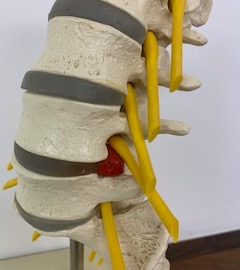
Sciatica refers to pain that radiates along the path of sciatic nerve, which branches from your lower back through your buttocks and down each leg into your feet and toes. The sciatic nerve is the largest nerve in the body. It usually affects one side but can affect both. Pain from sciatica is generally felt more into the leg than the lower back region.

What does Sciatic pain feel like?

Sciatica can be described in many ways depending on the cause. The pain can be stabbing, shooting, sharp, sudden jolts of pain, others describe burning, tingling, or excruciating pain sometimes with weakness too. The pain can be constant, or it can come and go.

What causes Sciatica?

Sciatica most commonly occurs when there is a disc herniation. Other causes of sciatica can be a bony spur, spinal stenosis (narrowing of the spine which compresses part of the nerve) spondylolisthesis, piriformis syndrome, pelvic tumours and pregnancy.

Risk factors

These can include Age, smoking, obesity and occupation – heavy lifting or twisting, sitting for prolonged periods.

How long does it last?

Sciatic symptoms are usually the most severe in the early stages when the compression and inflammation of the sciatic nerve are at their greatest. The length of time to improve is very dependent on the cause. Many patients will see improvement in 4-8 weeks, others may need medication such as anti-inflammatory and pain killers from the GP, or be referred for further tests such as x-rays or MRI scans to assess the lumbar spine further.

Tips on prevention

Practice good posture when standing walking and sitting.

Practice safe lifting techniques

Exercise to help maintain aerobic fitness and strength and flexibility in the spinal and core abdominal muscles.

Sit in well supported chairs with good lumbar/ back support. Using a lumbar roll or cushion can help. Take breaks and avoid long periods of sitting.

How can Osteopathy help?

As osteopaths we take a full detailed case history including your medical history to diagnose the cause of the sciatica. This will involve an examination of the lower back, hips and legs including power testing, sensation, and reflexes.

The purpose of treatment is to relieve pressure from the sciatic nerve which may include soft tissue techniques and mobilisation of the lower back to improve range and function. As osteopaths we aim to identify the cause of the sciatica and formulate a treatment plan for each individual patient. We would provide advice on exercises if appropriate and postures to help when sleeping or sitting.

In some cases, patients may need to see their GP for anti-inflammatory or pain killers to help with the pain. Some may need further investigations such as x-rays or MRI scans which we would refer if required

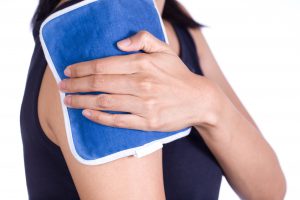
What is better for an injury, a hot or cold pack?

woman putting an ice pack on her shoulder pain

This is a dilemma a lot of people have when they first have an injury, and we are often asked in clinic what is better to use for an injury. This could be an acute low back that has just come on suddenly after you bent, a pain in your ankle after running making you limp or lifting awkwardly and feeling a pain in your elbow. What do you do? Ice or heat?

Here is some information that may help with your choice. If in doubt always speak to a practitioner or ring us for some advice we are always here to help.

Ice/cold

Ice is great for acute injuries, calming down superficial tissues that are inflamed hot or swollen. Cold treatment will reduce inflammation by decreasing blood flow into the area (vasoconstriction).

The inflammatory process is a healing, normal, natural, process which can also be incredibly painful. If you have had an injury in the last 48 hours ice can minimise swelling, reduce bleeding within tissues and alleviate muscle spasm and pain. Ice or cold can also numb the tissues and slow down pain messages to the brain.

Ice can also be used to treat more chronic conditions too, such as tendonitis or bursitis.

Tips for icing

  1. Never place ice directly onto the skin always use a cover.
  2. Keep moving the ice pack around do not just leave it in one place for too long.
  3. Ice for 15-20 minutes, this can be done numerous times during the day is appropriate.
  4. Never ice damaged or broken skin.

Hot/ Heat

Heat can be effective for relieving muscle tension; help relax tissues and help loosen stiff joints.  Applying heat to an area will dilate blood vessels (vasodilation) and increase blood flow into the area. Heat can be useful for chronic conditions such as arthritis or muscle pains and spasms. Heat can also be psychologically reassuring which can help reduce pain.

Tips for heat

Heat can be effective for relieving muscle tension; help relax tissues and help loosen stiff joints. Applying heat to an area will dilate blood vessels (vasodilation) and increase blood flow into the area. Heat can be useful for chronic conditions such as arthritis or muscle pains and spasms. Heat can also be psychologically reassuring which can help reduce pain.

  1. Do not use heat to treat an acute injury.
  2. Use moderate heat not burning hot!
  3. Do not use heat if there is swelling of any kind.
  4. Never heat broken or damaged skin.

Working from home

Working from home has never been so popular, but this year since COVID -19 it was estimated that 60 % of the UK’s adult population were working from home and that 26% continue to work from home once restrictions lessen. Employers are finding increased productivity, reduced costs and due to the current COVID – 19 updates are keeping employees at home for now.

Working from home is beneficial for many people however there are many down sides.

  1. Working longer hours, taking reduced lunch breaks
  2. Loneliness
  3. Poor ergonomic set up with poor desks/chairs and not getting up and about as you might do in an office regularly during the day.
  4. Harder to separate work and home balance
  5. Musculoskeletal aches and pains.
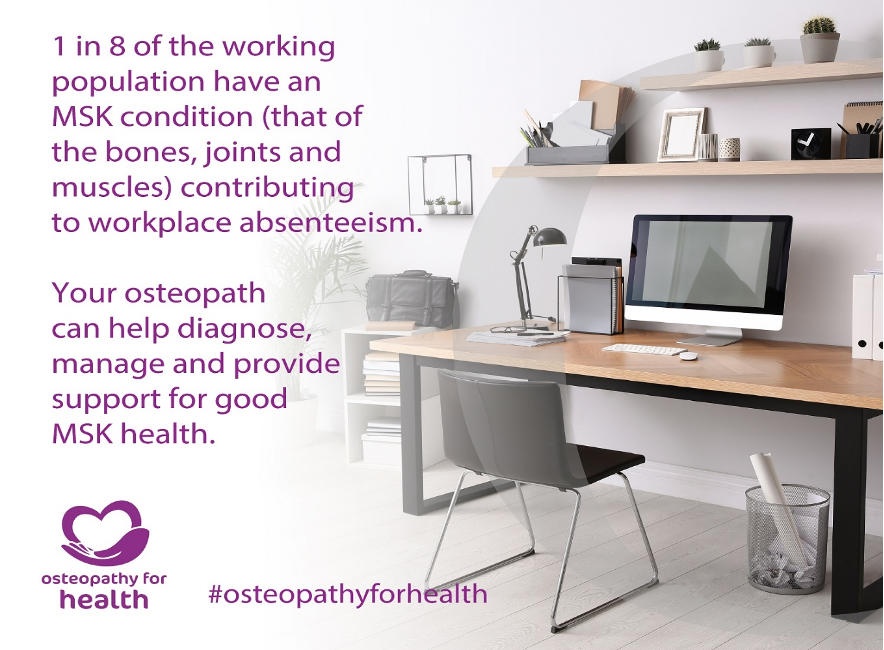
Photo of an abandoned office desk, with text that reads "One in eight of the working population has an MSK condition"
One in eight of the working population have an MSK condition (that of the bones, joints and muscles) contributing to workplace absenteeism. Your osteopath can help diagnose, manage and provide support for good MSK health.

So how can you optimise working from home?

  1. Take breaks – try not to sit for more than 30 minutes at a time, set an alarm to make sure you get up and move for a few minutes, normally in an office environment you would be up and down numerous times during the day.
  2. Ergonomic set up – make sure your desk and screen are at the correct height. Make sure your office chair is supportive and adjustable to meet your needs. Use a headset rather than holding the phone to your ear all day. Resting your feet on some books of a small step rather than having your legs dangle will help support your lower back and hips.
  3. Schedule in a lunch break to leave the room get some fresh air/ go for a walk or speak to other people.
  4. As a rule for every 20 minutes you spend looking at a computer screen you should spend 20 seconds looking at something 20 feet away. This gives your eye muscles a break helping reduce eye strain.
  5. Keep hydrated, make sure you have water regularly during the day.

If you would like some advice about how to optimise your ergonomic set up when working from home, just get in touch and see if we can help.

Due to the current COVID -19 crisis our practice has been adapted to meet new standards to keep you and us safe and healthy during these times. These include guidance by the Department of Health and social care (DHSC) Public Health England and NHS England, The Institute of Osteopathy and the General Osteopathic Council.

We have a produced a step by step guide to explain the current ‘patient journey’ as it may be different to what you have experienced before.

  1. The evening before your appointment you will receive an appointment reminder and a questionnaire to complete about any current symptoms you may have. If you suspect you have Covid 19 or any unusual symptoms, please call us prior and do not come in. We ask patients to bring their own masks with you for your appointment with us if you can.
  2. When you arrive for your appointment, we would ask you to arrive on time and wait in your car in the car park. We will call you on your mobile phone when it is time to come in. Please do not come to the door or use the keypad. We will greet you with the door open and walk you immediately into the clinic room with us. We would ask that you do not bring other people with you to your appointment unless you require a chaperone. Please leave coats/ extra bags in the car to reduce items brought in with you.
  3. We will be wearing full PPE which will include an apron, face mask and gloves.  We will also have a contactless thermometer to check temperatures.
  4. On entering the clinic room, we will ask you to wash your hands or use hand sanitiser which we will provide.
  5. During the consultation and chat we will place the chairs in the clinic a 2m distance apart and for as much of the appointment as possible we will keep a 2m distance. We are unable to use blankets to cover patients so we may ask you to undress for the examination and then if appropriate redress partially to allow you to be treated properly.
  6. Payment for treatment we ask will be card and contactless or if you prefer you can do a bank transfer after your appointment with us.
  7. On leaving the clinic room we will ask you to wash your hands or use hand sanitiser. We will walk you out of the clinic and out the main entrance.

Our clinic may look a little different as all books, joint models and surfaces will be minimised to allow cleaning. Pillows will be wipeable with no pillowcases or fabric plinth covers.

After each appointment, the room will be thoroughly cleaned before the next patient will enter the room.

We would ask if you subsequently have any symptoms of Covid -19 that you would inform us immediately by phone or email.

What to expect during your appointment

The following has been developed to explain exactly what to expect and answer some of the questions you might have. If you have any other concerns, please contact the practice by phone or email prior to attending your first appointment.

At the start of your first session, your osteopath will ask you to tell them about your problem. They will ask questions about your medical history and lifestyle as well as your symptoms. This is very important as it will help them to make an accurate diagnosis and suggest appropriate treatment. Your information will be recorded and kept securely.

The osteopath will need to examine the area(s) of your body causing discomfort. Sometimes the cause of the problem may be in a different area to the pain, (For example, a difference in leg length may result in compensations in the upper back which might result in neck pain) so they may need to examine your whole body. They will need to feel for tightness in the muscles and stiffness in the joints and may need to touch/palpate these areas to identify problems. They will explain what they are doing as they go along. If you are uncomfortable with any part of this, you have the right to ask them to stop at any stage without prejudicing your future treatment.

In order to examine you effectively, it may be necessary for your osteopath to ask you to remove some clothing as appropriate for the condition. Sometimes this might mean undressing down to your underwear. If you are uncomfortable with this, please make your osteopath aware of how you feel and discuss whether it might be appropriate for them to treat you whilst you wear shorts and a t-shirt.

The osteopath will suggest a course of treatment, which may require just one or several visits. They may be able to give you an estimate of how often they need to see you and any associated costs by the end of the first session. They will ask for your permission to provide treatment and you may be asked to sign a consent form.

Most osteopaths will begin your treatment at your first appointment, but sometimes they may require further tests first i.e. blood tests or scans. Occasionally they may diagnose an illness that they are unable to treat and may suggest that you consult your GP or another appropriate health professional. You may experience mild discomfort with some of the treatment techniques used, but osteopathic treatment is usually a very gentle process. Your osteopath will let you know if any discomfort is likely and it can be helpful to let them know what you are feeling. If pain persists after treatment, contact your osteopath for advice.

You are welcome to bring someone with you for all or part of your consultation. Children should always be accompanied by a parent or guardian. If you have any other questions, ask your osteopath.

Facebook
Twitter
Welwyn Osteopaths
Privacy Overview

This website uses cookies so that we can provide you with the best user experience possible. Cookie information is stored in your browser and performs functions such as recognising you when you return to our website and helping our team to understand which sections of the website you find most interesting and useful.